
A responsible partnership
Coor assumes full responsibility for the services delivered through our subcontractors. Procured services and goods count for a large share of our service delivery and have a great impact on both quality and cost. Consequently, we aim for good long-term supplier relationships and set high standards on our suppliers.

Responsible Procurement model
Taking responsibility for our suppliers has become as natural as taking responsibility for our own business.
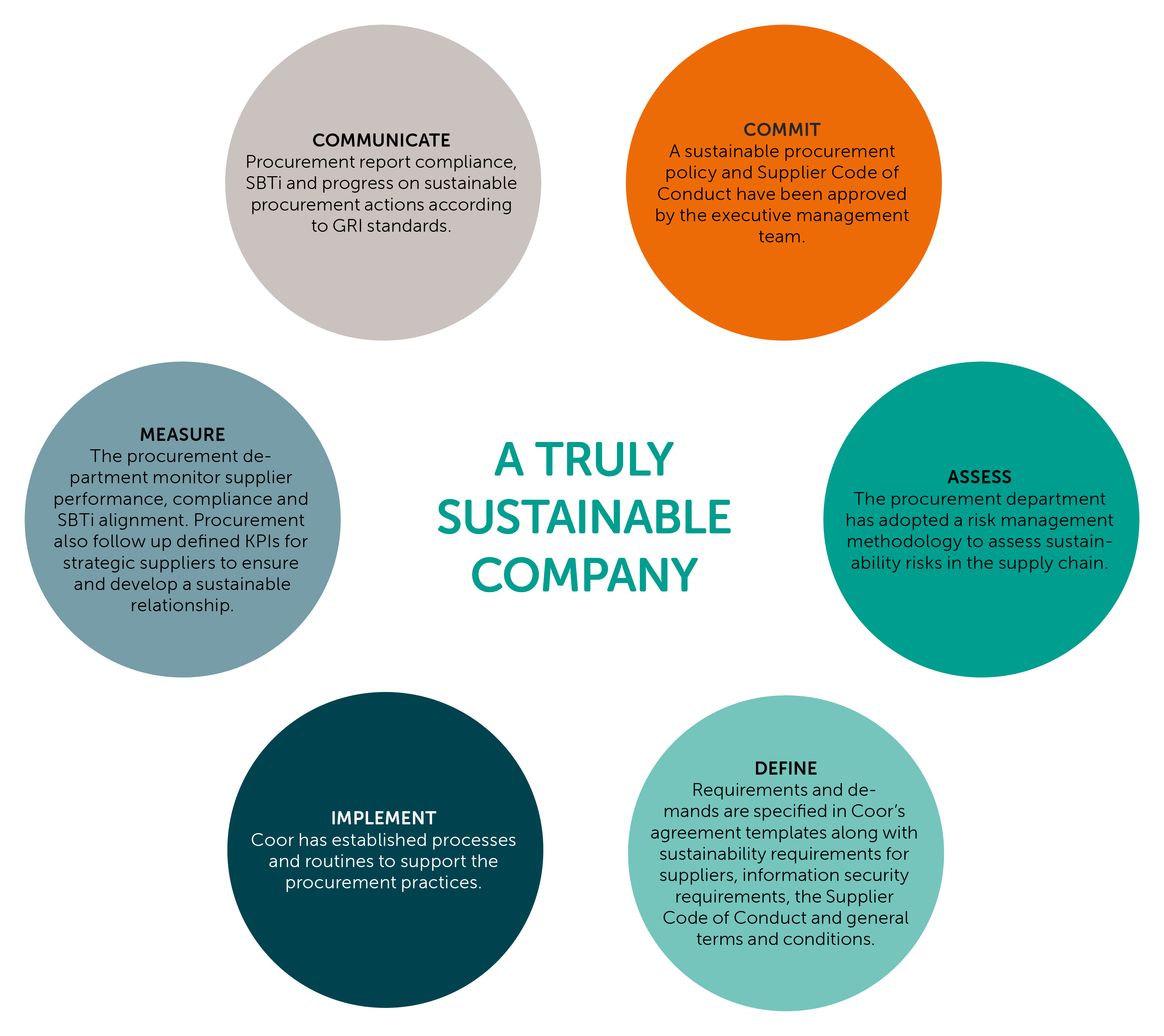
Coor Procurement is an integral part of the business and have a huge impact on its value chain. To achieve the impact on supply chain sustainability Procurement have adopted the UN Global Compact Management Model. The model is described in following process steps: Commit, Assess, Define, Implement, Measure and Communicate. Here you can learn how we have been inspired by the model in our daily work.
Responsible Procurement in practice


Assess
Read more about our risk management methodology to assess sustainability risks in our 2023 annual and sustainability report (pdf).


Implement
Category mangement is a systematic, holistic way of managing categories throughout the whole life cycle of products and services, taking into account all aspects of sustainable procurement in sourcing decisions.

Measure
A measurement at the end of 2023 showed that 18 per cent of Coor’s emissions come from suppliers with validated SBTi targets. Scroll down to learn more about our sustainability commitments.

Communicate
Read more about our actions according to GRI standards in our 2022 annual and sustainability report (pdf).
Read more about how we adress salient risks, works with mitigating activities and follow up in our Supplier Due Diligence Process (pdf).

Number of suppliers assessed for social impact*
*None of the relationships were terminated as a result of the assessment

Number of suppliers identified as having significant actual or potential negative social impact
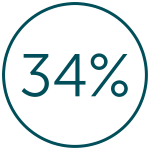
Percentage of suppliers identified as having actual or potential negative social impact with which improvements were agreed upon as a result of assessment
Coor and the Science Based Target initiative
Coor works with science-based targets. This means that Coor's climate goals are in line with the Paris Agreement and what the science says is required to limit global warming to 1.5°C.
One of Coor’s goals is to ensure that 75% of the company’s scope 3 emissions from purchased goods and services, upstream transportation and distribution come from suppliers with targets approved by the SBTi. In September 2022, we started informing our suppliers what this means for our continued collaboration by sending them this letter.


For existing and potential suppliers
Learn more on our local websites.
FAQ about SBTi for Coor suppliers
What do I need to do, and when, as a supplier to Coor?
As a supplier to Coor, your company needs to get your climate goals approved by the Science Based Target initiative (SBTi). Read more about how to join and how to get your climate goals approved on the SBTi's website.
The goals need to be approved by 2026, which means that you need to start the process of getting the goals approved by 2024.
What does Coor mean with our company needing to get our climate goals approved by the SBTi or similar?
This means that your company needs to commit to at least halving your greenhouse gas emissions by 2030 and reaching net zero by 2050, at the latest, and annually reporting your progress publicly. At the moment, the SBTi is the only organization that actively works to validate goals in line with the Paris Agreement and performs a qualified assessment. Coor therefore only accepts the SBTi as a third party as for now.
Will Coor end the collaboration if a supplier does not join and gets its climate targets approved by the SBTi?
In the longer term, this will affect which suppliers Coor chooses to cooperate with.
Who do I contact at Coor if I have questions about the SBTi and climate goals?
Your regular contact person in Coor's procurement department is also the person who can answer questions about Coor's work with SBTi. If you have general questions about climate goals and Science Based Targets, please see the FAQ on SBTi's website.
Can Coor help our company to join the SBTi?
Coor cannot help you to join the SBTi. There are consulting companies that offer companies help with this.
What do our company need to do to prove that we have joined the SBTi?
Inform your contact person at Coor’s procurement department that your company has joined the SBTi.
Our company has already had our climate targets approved by the SBTi. What does Coor need from us?
If you have already had your climate goals approved by the SBTi, you only need to inform Coor. If you have started the process, we need information about when it is expected to be completed and also when it is completed.
What happens if our company has joined the SBTi but doesn’t get our climate goals approved in time?
As long as we are sure that there is a will and that there is progress in the work of getting the goals approved, we are happy to follow you in that development.
It says that 75% of Coor's scope 3 emissions should come from suppliers who have had their climate goals approved by the SBTi. Can our company continue to deliver to Coor as usual without joining the SBTi?
Coor's procurement and supplier base varies over time and according to our customer’s needs. It is likely that the suppliers that account for 75% of Coor's scope 3 emissions today will not do so tomorrow. That is why all Coor's suppliers eventually will need to join the SBTi. In the future, this will be required in order to become a supplier to Coor.
Does our current agreement with Coor still apply?
Already signed agreements are valid with unchanged terms until something else is agreed.
Does it cost anything to join the SBTi?
The price of joining the SBTi depends on the size of the company, based on the number of employees. If you have fewer than 500 employees, your company is counted as SME and then it costs USD 1,000* to join. For other companies, the cost is USD 9,500*.
*As per September 2022
How does our company benefit from joining the SBTi?
By joining the SBTi, you ensure that your company’s climate goals are in line with the Paris Agreement and what science says is required to limit the global temperature increase to 1.5 degrees. It strengthens your actual sustainability work and your sustainability profile. In addition, more and more companies are joining SBTi, which means that more companies are expected to make demands on their supply chains like Coor.
Read more about companies that have joined the SBTi and how it has strengthened both the company's sustainability work and business on the SBTi's website.